
Resident Evil: requiem
Benchmark Officer: David Roberts , Creative Director
Version: Steam PC, February 27th, 2026
Engine: Reach for the Moon (proprietary)
Settings: All Settings Max, alternating between Path Tracing & Ray Tracing High due to poor performance between Leon’s open sections in the Raccoon City biome.
Hardware: Asus TUF 5080 16GB VRAM, Intel i9 14900K, Corsair Vengeance 64GB DRAM 3200MHz DDR4, WD Black SN850X, LG 3840×2160p TrueBlack HDR400 OLED, 8BitDo Ultimate 2 Wireless 1000Hz polling, TMR joysticks & HE triggers
Framerate: 3840×2160p, 120 FPS, DLSS Quality, Ray Tracing High (No Frame Gen Needed) / 3840×2160p, 60 FPS, DLSS Balanced, Path Tracing (4x Frame Gen to 240Hz) with sub-40 FPS during Raccoon City Biomes (considered unplayable, and unusable for Frame Gen)
Media: Screenshots used are graded to match (by eye) what is seen on the monitor, Rec.2020 captured in H.264 with to Rec.709 conversion exported in 2160p sRGB final JPEG.
Please Note:
This benchmark is formatted for best viewing on a PC or Laptop. Titles are benchmarked for market position, and will be addressed in context. In this case RE: requiem (stylised lowercase r) is a mainline title in the series that aims to bridge the original canon and the post-Resident Evil VII reboot canon. RE: requiem follows Alan Wake II in tackling a dual-protagonist narrative, and semi-open urban environment, as such will be treated as a contender, not an originator.
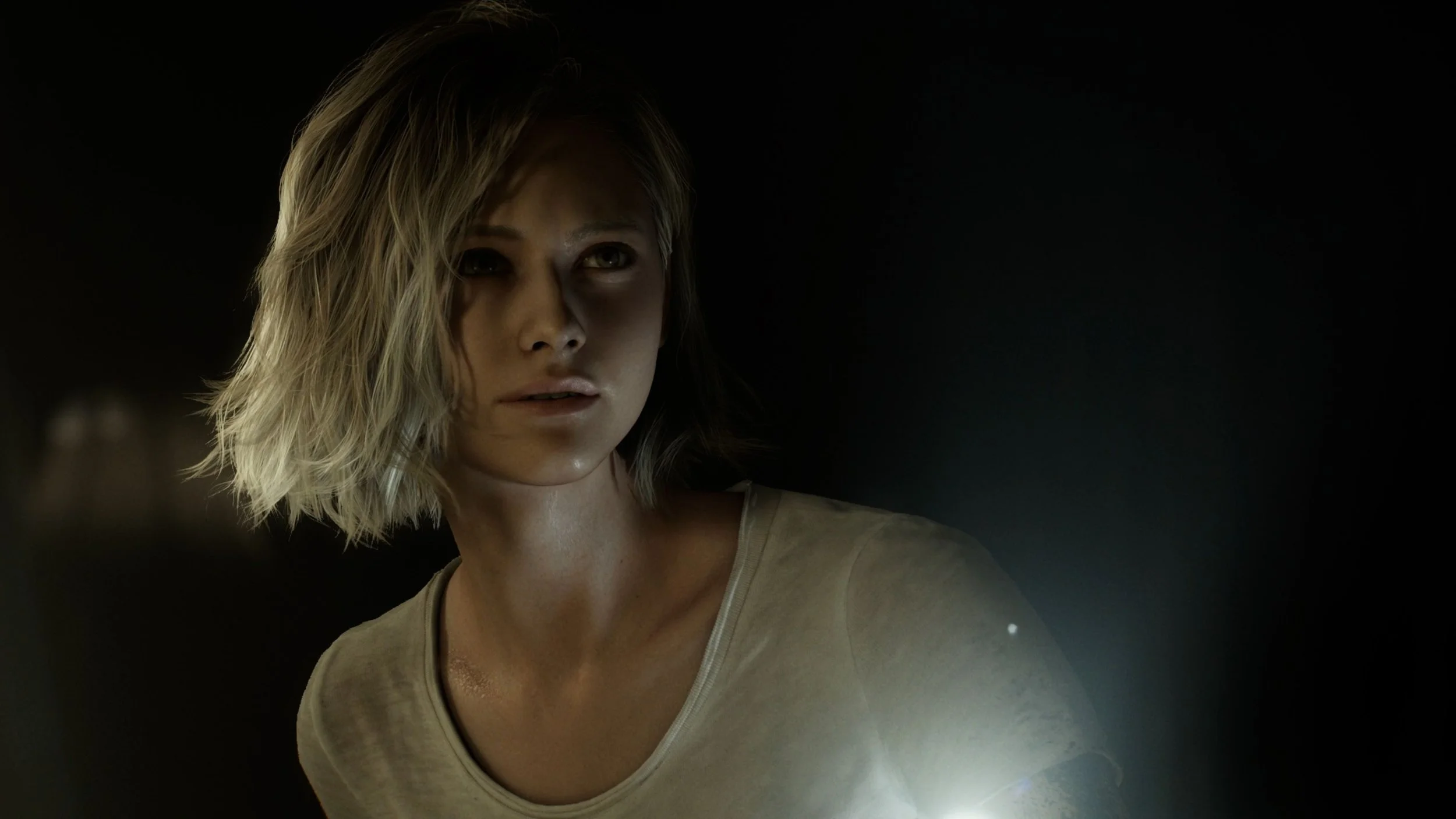
My immediate thought on RE: requiem is that is is a game of two halves. It is a title suffers not from identity crisis, but from a lack of distinct separation. Unlike Alan Wake II, where the player is given an adequate amount of time with both Alan and Saga, I often found myself wanting to spend more time as Grace or Leon respectively. Also, unlike Resident Evil 2 (2019), and to a closer extent Resident Evil 4 (2023) and Separate Ways, with both recent entries taking a different but separated approach between Leon & Claire, and Leon & Ada respectively. This was a development choice that has been made to bridge two separate fanbases at the detriment to the overall quality of the experience. Sales, user metrics, and journalistic reception would say otherwise, but I believe my initial thoughts will be proven correct by time. This is the first original — and I use the term loosely — entry into the mainline series since arguably Resident Evil 0, and as such initial thoughts and public reception should be taken with that into account. The industry leading (in many areas) execution, and overall novelty of a canon Resident Evil alters the perspective in a major way. The only takeaway to be had from this exact scenario is that when an IP is left dormant, undergoes radical identity change and returns to form, expectations are skewed. In this sense market categorisation leans closer to a title such as Call of Duty: Modern Warfare (2019), than prior original entry; Resident Evil: Village. This is also a direct design parallel to what I consider the current genre and generational watershed — Alan Wake II, and Resident Evil’s direct competitor — Silent Hill f.
In my YouTube first impressions I rated the first 45 minutes of the game 10/10 arbitrarily, as a number helps understanding. I also critiqued it quite heavily, as industry leading is not perfection. Video games by their very nature are also prone to many flaws that are mitigated in cinema, literature, or even still imagery. The 10/10 descriptor was given with that in mind, it is far harder to critique flaws in an open interactive space, than a 2D still. The arbitrary designation was also given with the exact blinders I stated above, is it good for a Resident Evil? And that answer is a clear yes. Is it a good survival horror game, or even a good video game? That too is a definitive yes. The question I will attempt to tackle is if it is good regardless of the medium, which the closest competitors can lay a strong claim to being. It is worth noting that these are not reviews, these are internal benchmarks that prioritise artistic direction, narrative, and touch on technical execution. My initial impression upon completion remains the same, this is a definitive Resident Evil experience, and watershed title of 2026 regardless of genre.
Before we begin to speak in broader terms, there are points I wish to address regarding what was intended by this instalment and how this materially affects perception. The first is that much like Capcom is known for, this title utilises heavy asset reuse, both from in-game assets to wholesale environmental meshwork from prior titles. I can only allude to the fact that the Wrenwood Hotel is a re-skin of the Baker Family Mansion, but Raccoon City and in particular Raccoon City Police Department, Gun Shop Kendo, and the most literal; Racoon City Orphanage. I will eventually tackle the subject of whether this is a strength of the series, or more akin to Devil May Cry 4, but for now the parallel I want to broach is that this is clearly a return narrative, and as such two things immediately stood out to me. The first being that this was done impeccably well in Dead Space 2, with the return to the docked USG Ishimura. Secondly, that the motorbike scene heavily drew inspiration from Resident Evil: The Final Chapter (Paul W.S Anderson, Sony), which at the time drew headlines due to the tragic life-altering accident of stunt rider Olivia Jackson. The final point I wish to broach is how late-game segments regarding Leon S. Kennedy’s T-Virus infection induces hallucinogenic segments of gameplay similar to an early-version of Resident Evil 4. Whilst these points in no real way affect or alter how this benchmark will be processed; it can be said with certainty that these are ineffably important to the game, and to a greater extent Resident Evil as a franchise.
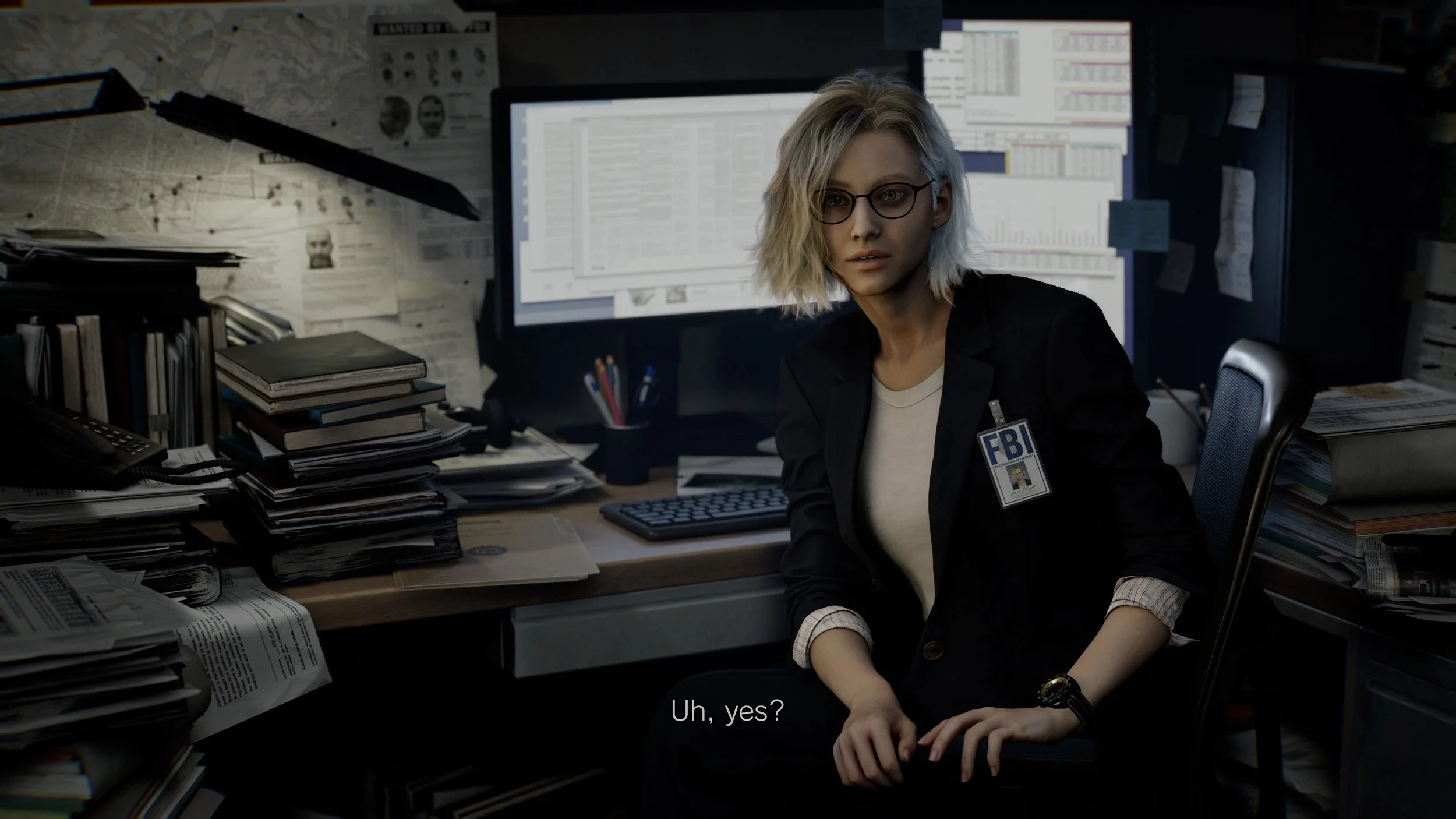
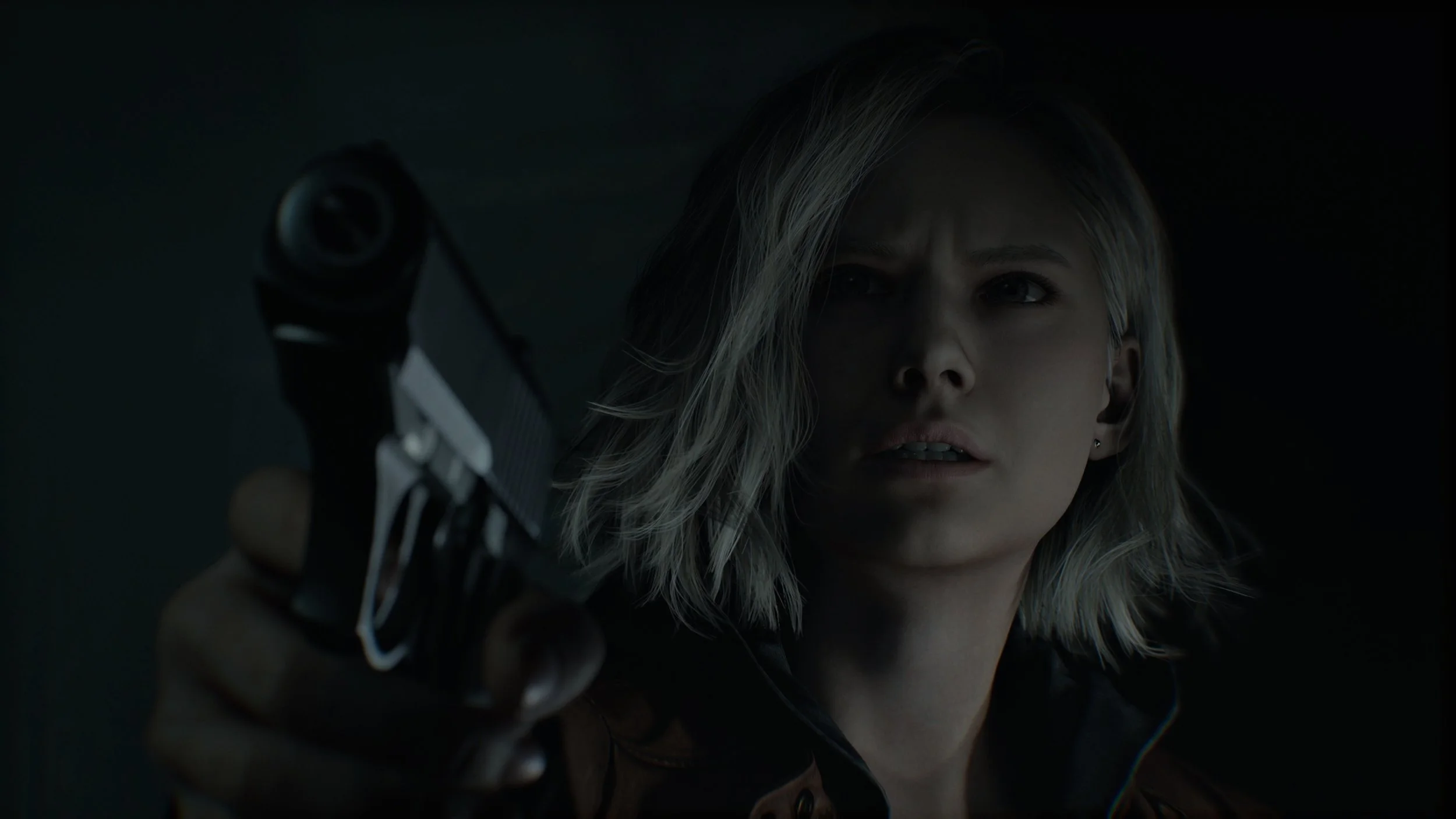
As you can see in the still above, the game is introduced using a Hollywood-esque contemporary cinematic look, currently defined by heavy shadows, ochre tinge and teal accents. There seems to be an underlying layer of magenta to the image, likely to aid in skin tones. Grace is introduced using a series of close-up cuts in quick succession, highlighting her obsessive nature and relatively unorganised persona (along with signature Hamilton timepiece—for better or worse). Our first true introduction is in this typical reverse over-the-shoulder medium shot, that expands into a wide. This is of note as the standard angle at which Grace is viewed, giving her a diminished appearance within frame. This is purposefully reversed at key moments, such as the frame below, when we first see her reach for her government-issued sidearm. This time, leaning heavily on a rule-of-thirds placing and what is commonly referred to as a leading line (from muzzle to mouth, then naturally to the eye). This is in stark contrast to Silent Hill f, that relied on a warmer palette and off-kilter indie compositions that leaned either too symmetrical or radically off-balanced. In contrast, the almost perfect asymmetry of RE: requiem gives the title a grounded, Western feel. This is a trend that continues through the majority of game, with later sections leaning towards a desaturated, then clinical palette for Raccoon City and ARK respectively.
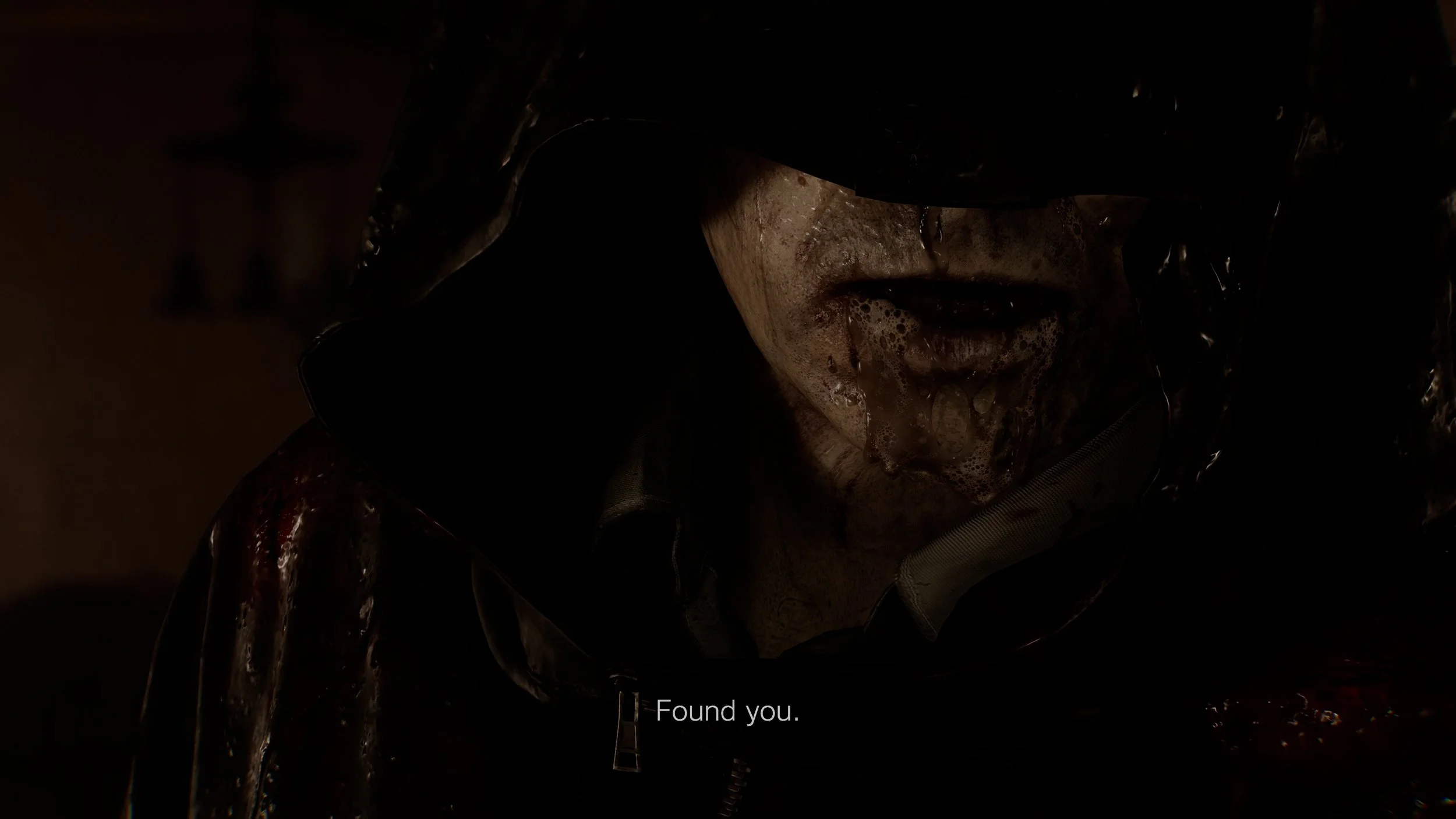
The reasoning behind these choices are fairly obvious, the prestige look of a Nolan film defines the current thriller aesthetic which Capcom is consciously using to subliminally place the title within audiences perceptions. However, and this is where I stated that the game itself does not suffer from identity but from separation, the game would have you believe at many points that it is a Fincher series, Hammer Horror, or an 80’s slasher. It never outright tries to be anything but a Resident Evil, with megalomaniac villains that border on parody and a healthy dose of John Carpenter (and Kurt Russel) worship. That said, there is no denying that the scene below (and the entire flashback sequence) is not an ode to slasher films. The issue isn’t in its existence, but in that at the time of this scene we had only just met Grace, and played as her for ten to fifteen minutes at most. At this time the player has yet to understand what exactly RE: requiem is, and the first impressions are likely to be heavily skewed by past familiarity. As touched on, the Wrenwood Hotel (whilst unconfirmed) bears striking resemblance to the Baker Mansion of Resident Evil VII, coupled with a recommended first-person perspective, it leads us to believe the game may in fact be closer to the rebooted canon post-Ethan Winters and Mould. This is not the case. It is firmly back in the T-Virus and Spencer timeline. I often praise Japanese media for their ability to understand pacing and the power of the void. Unfortunately Capcom has decided that the player must understand Grace’s motives this early, a decision I would have been braver with.
This is where despite flawless presentation, execution in the early stages are objectively lacking. Capcom has hedged on the average consumer and rather than allowing space for the narrative to breathe, introduces Leon as a secondary playable character. The choice was clearly made to allow players to experience both the Grace and Leon campaigns within the first hour, in the hopes that should a player be more interested in one over the other, knowledge that a complimentary campaign exists will be enough to maintain attention. This is at detriment to the overall experience and in my opinion, subjectively worse than separating campaigns. It is not objectively worse, with Alan Wake II, Call of Duty Modern Warfare (2019), and The Last of Us II (despite the contents of each campaign, the split is executed objectively well) setting precedent for multi-protagonist campaigns executed effectively. I would state that in relation to how Grace and Leon will exchange control during intersections as the two meet, Call of Duty Modern Warfare (2019) stands as the current watershed for this specific execution. In comparison RE: requiem takes an unbalanced approach, with Leon’s early sections brief and contained, yet later dominating and open-ended. During the final moments of the game the roles are reversed with Leon narratively and mechanically weaker than Grace, yet instead of a profound shift in player empathy it does nothing but exacerbate the disconnect. A prime example of this very scenario done well would be The Last of Us, where gameplay following Joel’s injury at the University, gameplay switches to Ellie (and away from Joel for the first time since Sarah during the intro). Joel is seen with a high fever in the dead of winter as Ellie is left to forage in a snowy village. Where there is no miracle cure or ex machina to speak of, only a horrifying ending to a horrifying experience. Grace on the other hand is immediately given an overpowered weapon in the Acid Bottles, that allow her to take down franchise defining enemies such as the notorious Licker with a single hit. This takes away from the prior struggle where once a single infected would have been a challenge, and emasculates Leon rendering the power fantasy campaign redundant thematically.
In terms of gameplay, for someone who is rather versed in the genre Grace’s initial gameplay through the Rhodes Hill Asylum is confusing and in hindsight meant to be split 50/50 with Leon. I personally played Grace’s sections as I would RE: VII or RE: Village, clearing rooms and enemies whilst “farming” for items. This in itself was no issue, it leant into a tense and overall modern Resident Evil experience. However, when gameplay switches to Leon, he is greeted with an almost entirely cleared biome outside of the player-locked sections. This not only affects gameplay as the sections become tedious back-tracking “filler” but reverses the combat narrative between Leon and Grace. The gameplay loop as Grace is not so complex that a player with relative contextual awareness can easily pivot to a strategy such as cheesing the Hemolytic Injector, for not only one-shot kills, but preventing further mutations of downed enemies. Requiem ammunition for the overpowered titular revolver is also fairly abundant within locked drawers, more than sufficient for clearing tougher enemies such as The Chef; a Tyrant/Jack Baker-esque foe. This creates an immediate and visceral disconnect between what the developers are portraying (a vulnerable girl) and the reality of the player (an overpowered legacy hero with nothing to actually do, as said girl just Rambo’d her way through).
Considering that Survival Horror is historically tied to iconic hospital-esque settings RE: requiem does a good job of differentiating itself from Silent Hill 2 and Resident Evil Alumni Shinji Mikami-sensei’s The Evil Within. The latter of note as a return to Survival Horror proper after years of virtually zero major releases within the genre. I have personal experience as a Sony PlayStation representative during retail marketing launch of The Evil Within as it was a prime title during the holiday push of 2014, especially after the poorly performing Assassins Creed Unity, and a large pivot was made to use the title as the flagship for an adult demographic and an early instance of Point-of-Sale push for DLC. In fact if comparisons are to be made, the hospital prologue in Metal Gear Solid V: The Phantom Pain would be a closer parallel to RE: requiem both mechanically and narratively. Unfortunately this is not a favourable comparison, with MGSV: The Phantom Pain excelling at portraying a helpless character through the Ahab/Ishmael duality. In a vacuum, if we are to remove Leon’s presence from the equation, initial Rhodes Hill segments as Grace are a well-executed (if an unoriginal P.T-esque) extension of RE: VII and RE: Village. Asset reuse is not overt, though familiarity to RCPD is clearly present, but can be forgiven considering the likelihood that both buildings would likely have been constructed around the turn of the 20th century. As you can see below this scene is a direct call-back to Resident Evil 2 (2019) where Leon finds himself in a dark hallway with the path barred by a missing fuse.
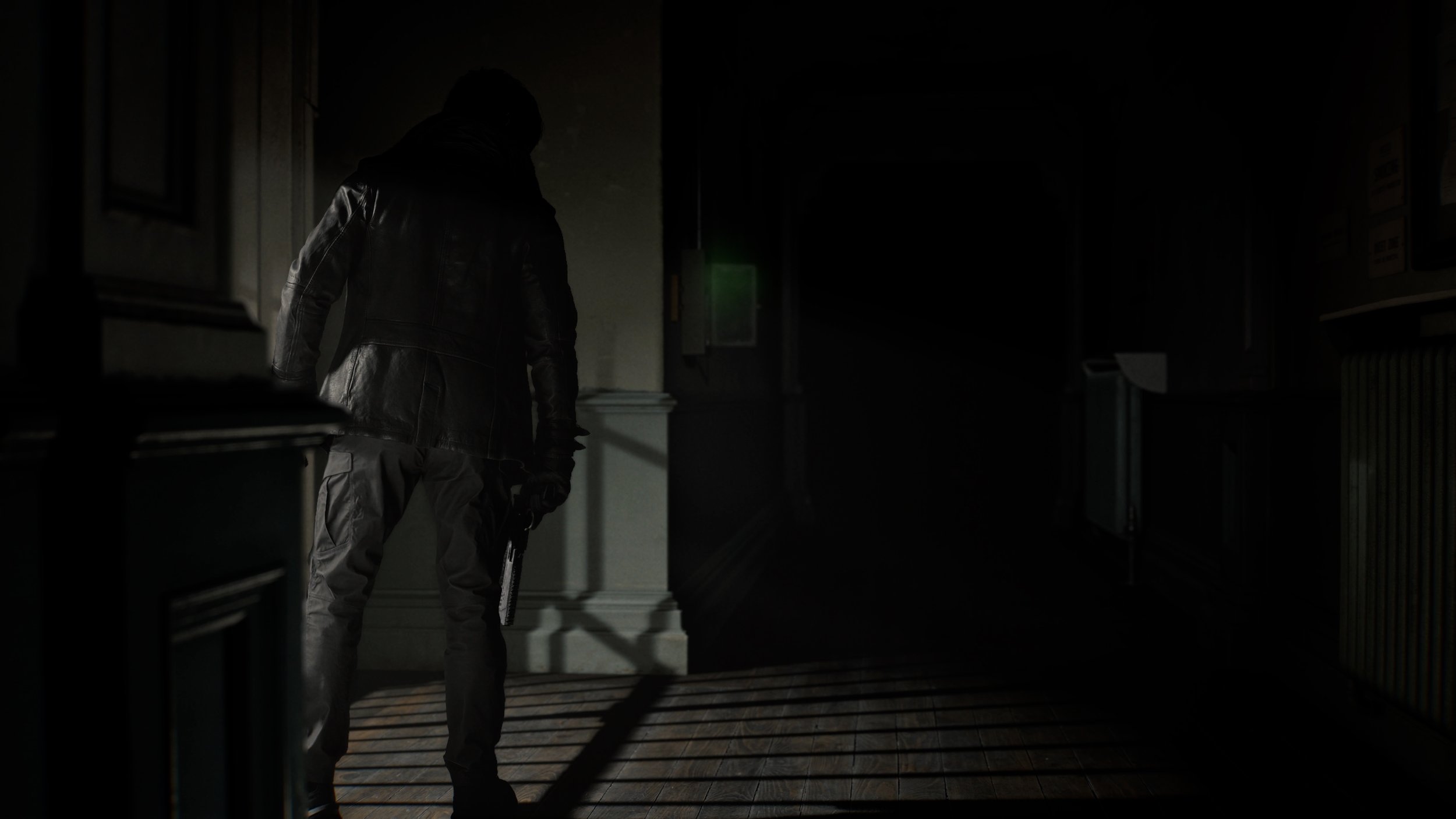
From beginning to completion of the first section, which I consider to end at Rhodes Hill before advancing to Racoon City, gunplay is sparse. Whilst Leon’s interjection later as marksman cover for Grace and Emily is the first time where I truly saw excitement, it was over all too quickly. A common trend that does not dissipate as we advance trough the game. Mathematically, an eight to ten-hour experience divided by two will only allow for four to five-hours per storyline if balanced equally, a tremendously small amount of active user time considering Separate Ways clocks in at five to six hours alone. Less noticeable — but still present — during this section is the animation frame timings. Whist there is a fluid and high-fidelity movement to the avatars of both Grace and Leon, action is hampered by wind-up keyframes. Although this does not remove from player satisfaction, it does actively disregard advancements in input technologies that my very own Project Alpha concentrates on. The keyframe timings are obvious and noticeable when using instantaneous inputs such as Hall Effect or micro switches, and high-polling devices. For this reason, I believe that the title will age less gracefully than the low-latency developed for VR centric titles such as RE: Village. This will force players to experience tremendously different sections of gameplay to replay sections they may be more fond of. In a series with annual to bi-annual cadence this may not be a negative for Capcom, but for a title aiming for long-tail relevance I believe this is a counter-intuitive move. For 2026, Resident Evil is the current watershed but I strongly disagree that this will age well, or that consensus will remain as strong as prior entries. On recent replay, the novelty was not retained and I often wondering when I would actually do something next before being disappointed by how quickly those bursts of action were over. In contrast to RE: Village or Resident Evil 2 (2019) where encounters were brief but adequately Pyrrhic leading to relief at their passing and time to consolidate or “farm” for resources.
In general, this carries through to the final act, with Grace encountering a culmination of her stylistic playthrough before we are introduced to Leon proper and he becomes the sole playable character through the contentious open-plan Racoon City biome, the motorcycle sequence touched on, the Racoon City Police Department/Orphanage re-tread, and finally the Umbrella Laboratory. In hindsight, Leon’s role serves as play-time padding for an already short run-time, and this becomes quite obvious when taken in retrospect. There is very little positive to say regarding this section of the game, as there is a major reduction to Path Tracing performance (both expense and output). Gameplay also regresses into a find-three-parts fetch quest through a sterile, uninhabited section of city outskirts. Though fidelity does increase once we re-enter Racoon City proper, linearity and familiarity take away from any perceived benefit of the tighter structure offered. I believe this a fair assessment due to the install base of Resident Evil 2 (2019), though for some the Police Department et. al. would be novel.
After full assessment I stand by my initial impressions, RE: requiem is currently the leading foot for both the franchise, the genre, and sets visual expectations for the the medium as of mid-2026. Yet I do not believe it will be remembered in hindsight as fondly as the second, the fourth, or even the seventh instalments. Path Tracing during the initial sections of the game are visually stunning and indicative of an entire generational leap, but once the novelty subsides the execution is flawed. As of writing the boost to Capcom’s credibility from this entry is obvious, with goodwill transferred critically and commercially into the new IP, Pragmata, and likely to continue into the Onimusha reboot later this year. I believe that within the franchise RE: requiem sits in a similar spot to Resident Evil 5, which was on release the best-selling Resident Evil title, but has aged poorly and is not favoured by the fanbase.
Banshee Interactive claims no ownership over the properties evaluated within this article. This article is published under fair use as an independent critical analysis (transformative/educational). All stills taken from a version of the title purchased through Valve Corporation’s Steam storefront (unaffiliated).